Every fall, Luke loads up his wife Carolyn and their four kids and makes the drive out to Grandad’s Apples in Hendersonville, about two and a half hours from Charlotte, tucked into the mountains near Asheville. It’s a haul, and every year they debate whether it’s worth carving out the whole day for it. Every year, the whole family agrees that it is.
There’s u-pick apples, a pumpkin patch just opening for the season, a corn maze, and kids running through piles of leaves just looking for the pefect spot to launch into. The family comes home with a trunk full of apples, a box of cider donuts that rarely survives the drive, and four kids who are, without fail, asleep before they hit the driveway.
But while going to the apple orchard is a special treat, it’s where the family ends up most Saturdays in the fall that is one of Luke’s favorite places.
Coming Home to the Screened Porch
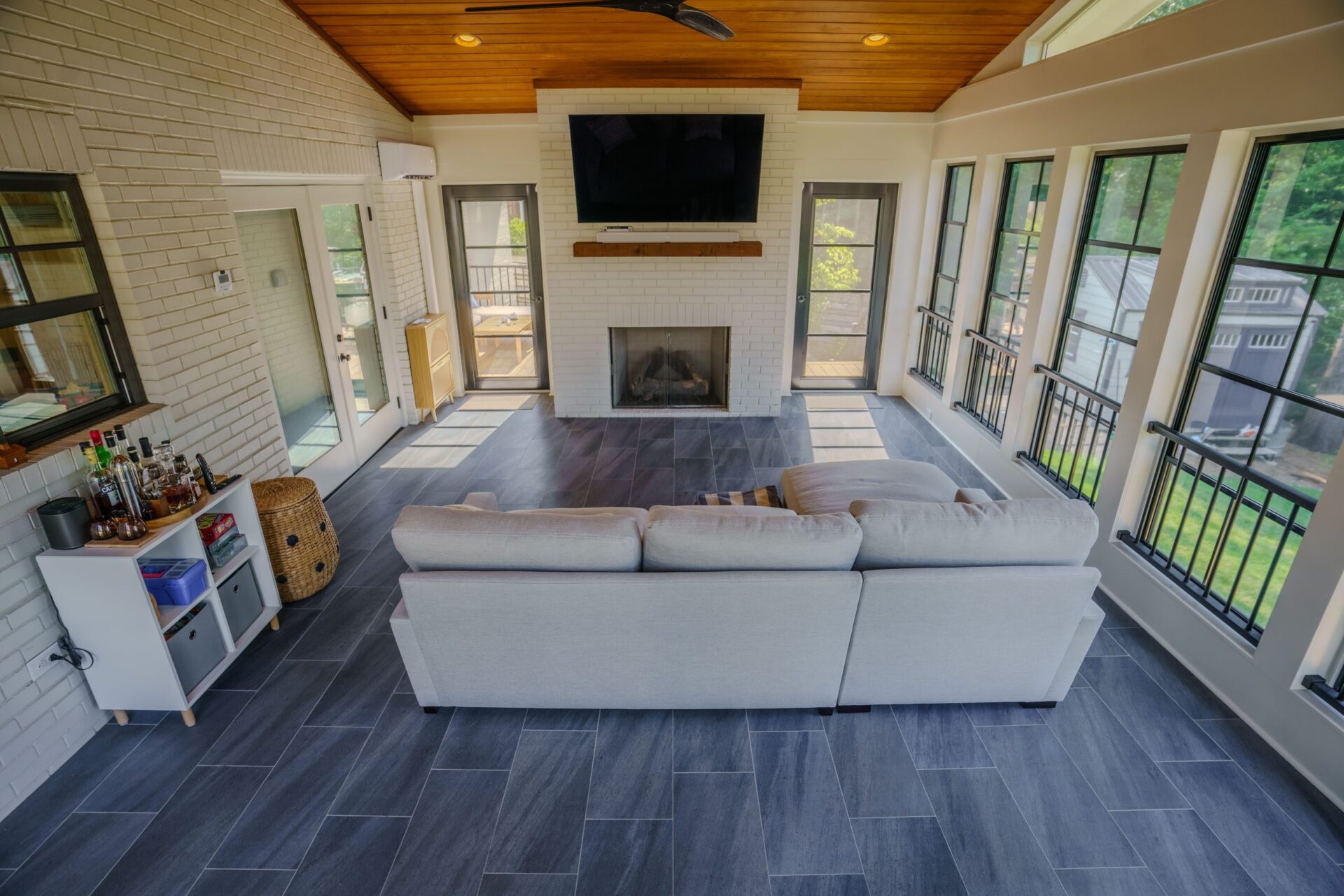
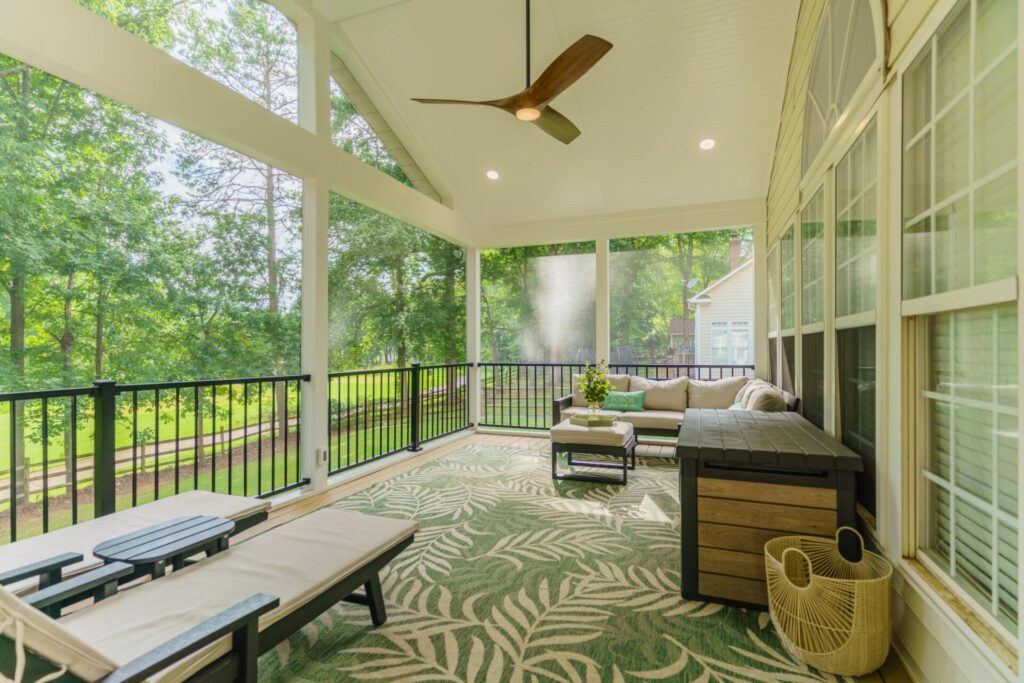
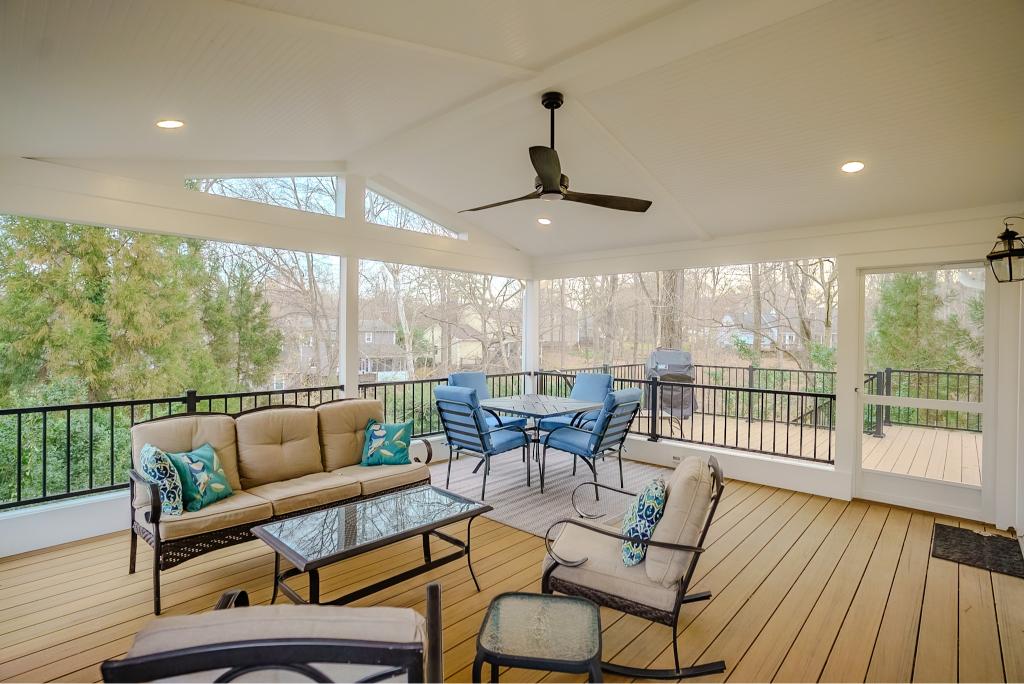
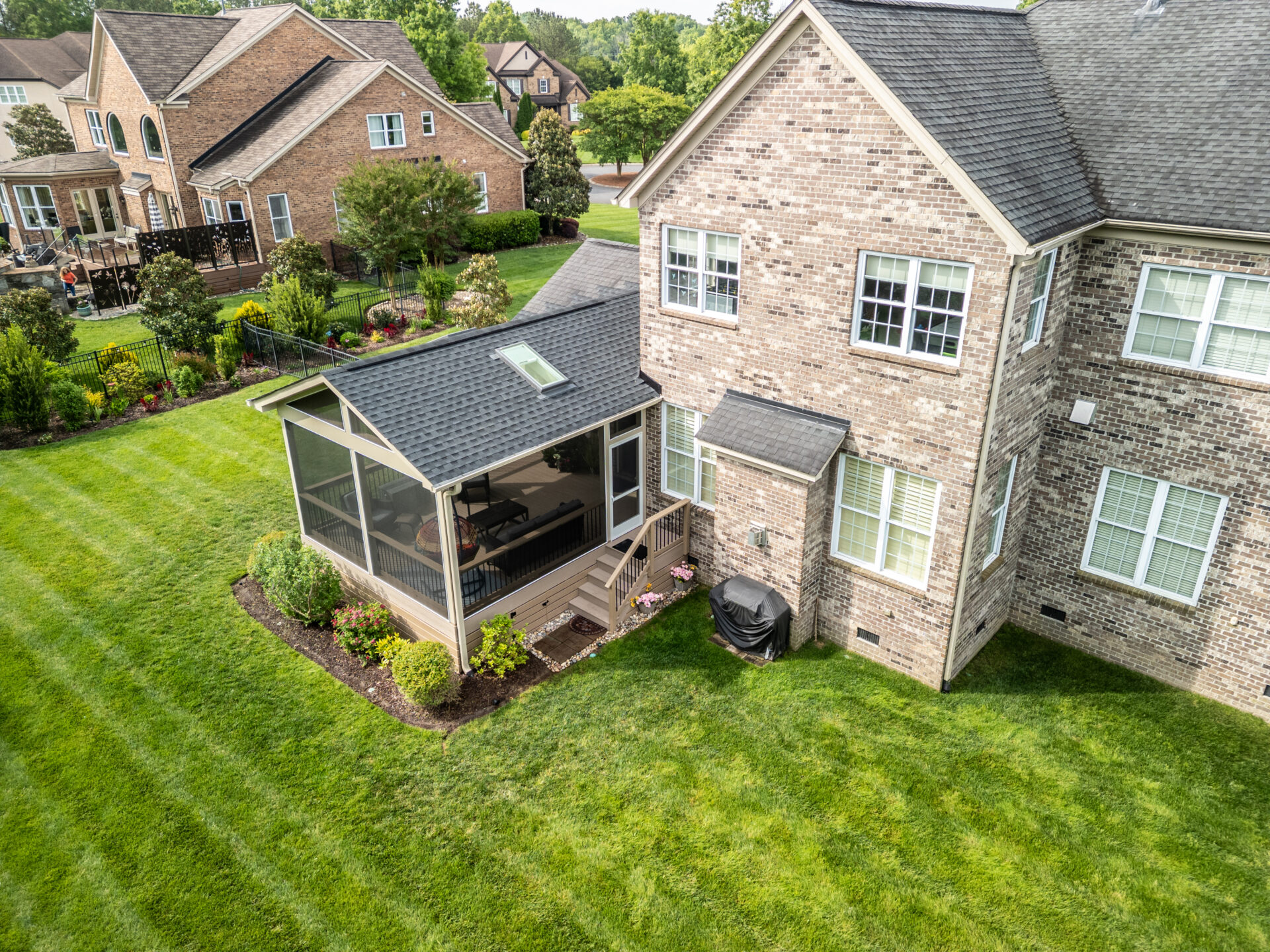
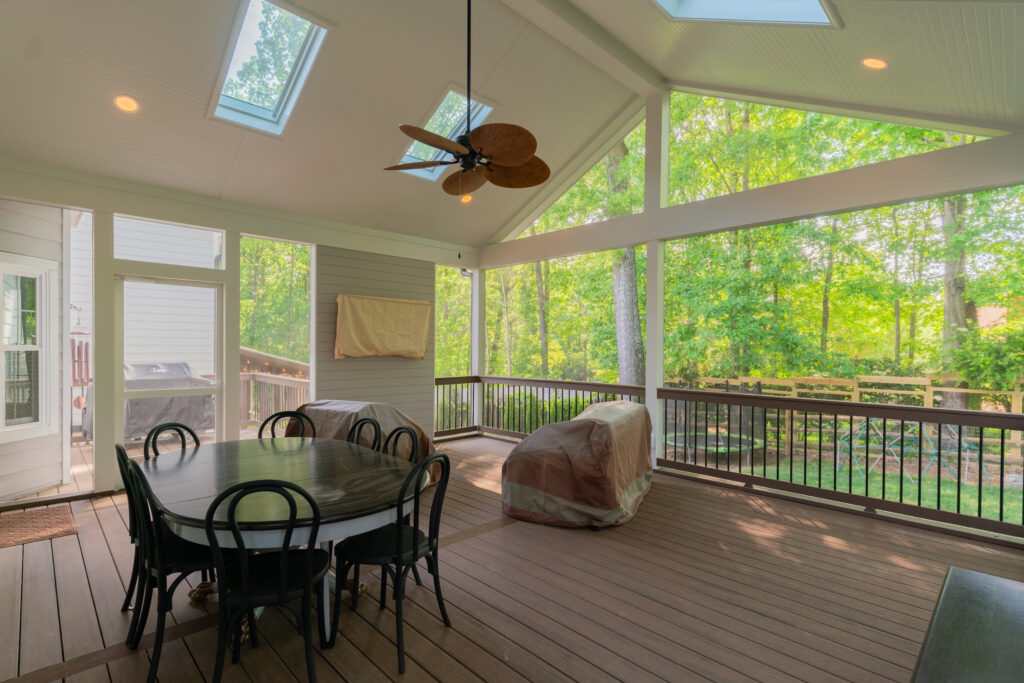
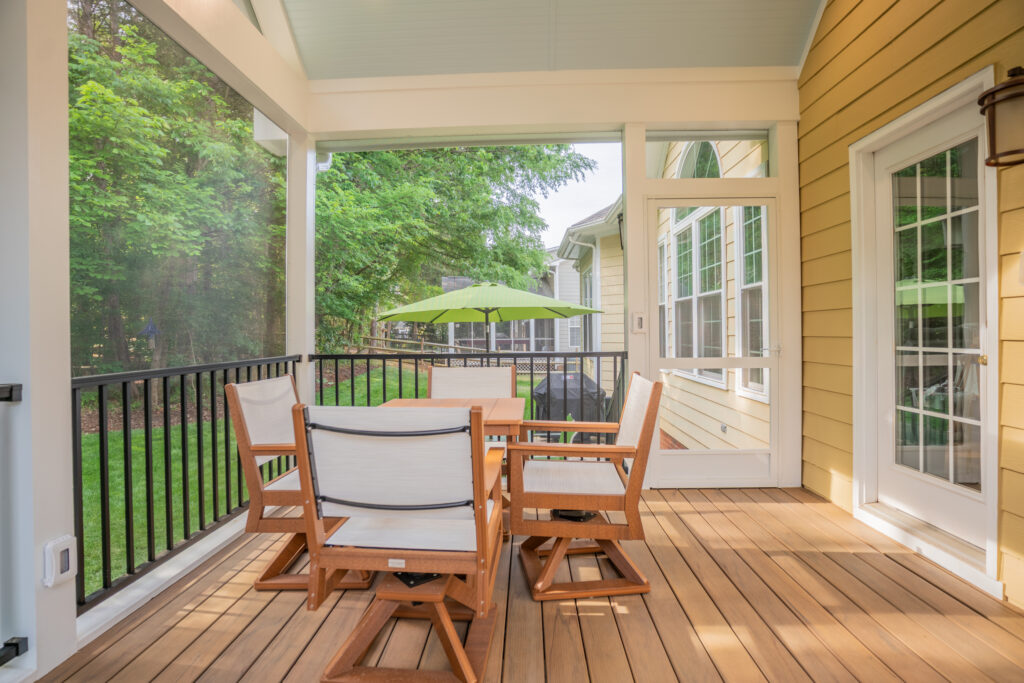
Once everyone’s home, Luke’s routine is almost always the same: pour a glass of cider, and head straight for the screened porch. It’s the room he built specifically for this. No bugs, no need to bundle up, just the cool of a fall evening with the screens doing their job and the kids winding down without anyone needing to be inside.
“It’s not complicated,” Luke says. “I just wanted a place where we could actually sit outside in the fall without fighting mosquitoes or hauling blankets around. It’s simple, but it’s just what we love.”
It sounds simple because it is. But it’s also, not coincidentally, the exact thing a well-built screened porch is supposed to do, and the reason it’s one of the most requested builds we do heading into fall.
An Outdoor Kitchen Built for Charlotte Game Days
The other fixture of Luke’s fall calendar has less to do with apples and more to do with Alabama football. Saturdays that aren’t spent at the orchard usually end with friends and family gathered around the outdoor kitchen on his deck, something on the grill, the game on, and a level of noise that makes it very clear whose team just scored.
“I built the outdoor kitchen because I wanted people to actually be out there with me, not stuck inside while I’m out back flipping burgers alone,” he says. “Cooking’s better when there’s people around. That’s kind of the whole point of an outdoor kitchen.”
Luke at a Fall football game with his dad, both longtime University of Alabama fans with a soft spot for the Carolina Panthers too!
Why This Isn’t Just a Business to Luke
Ask Luke why he does what he does, and he doesn’t talk about square footage or composite decking specs, at least not first. He talks about the porch, the orchard trip, Saturdays with the kids underfoot and the grill going.
“Outdoor living isn’t a just a title we put on our website. It’s literally how my family spends time together. That’s the whole reason I do this. I want other families to have their version of that, whatever that looks like for them.”
It’s a simple thing to say and a harder thing to actually build toward, but it’s the standard behind every project we take on as one of the Charlotte deck builders who thinks about a backyard as more than square footage: not just a deck or a porch, but a space that becomes the place a family actually gathers, season after season.
Building Your Own Outdoor Living Space in Charlotte This Fall
If you’ve got your own version of Luke’s Saturday in mind, whether that’s a screened porch for quiet fall evenings, an outdoor kitchen built for game day, or a composite deck that just needs updating before the next round of gatherings, fall is a great time to start that conversation.
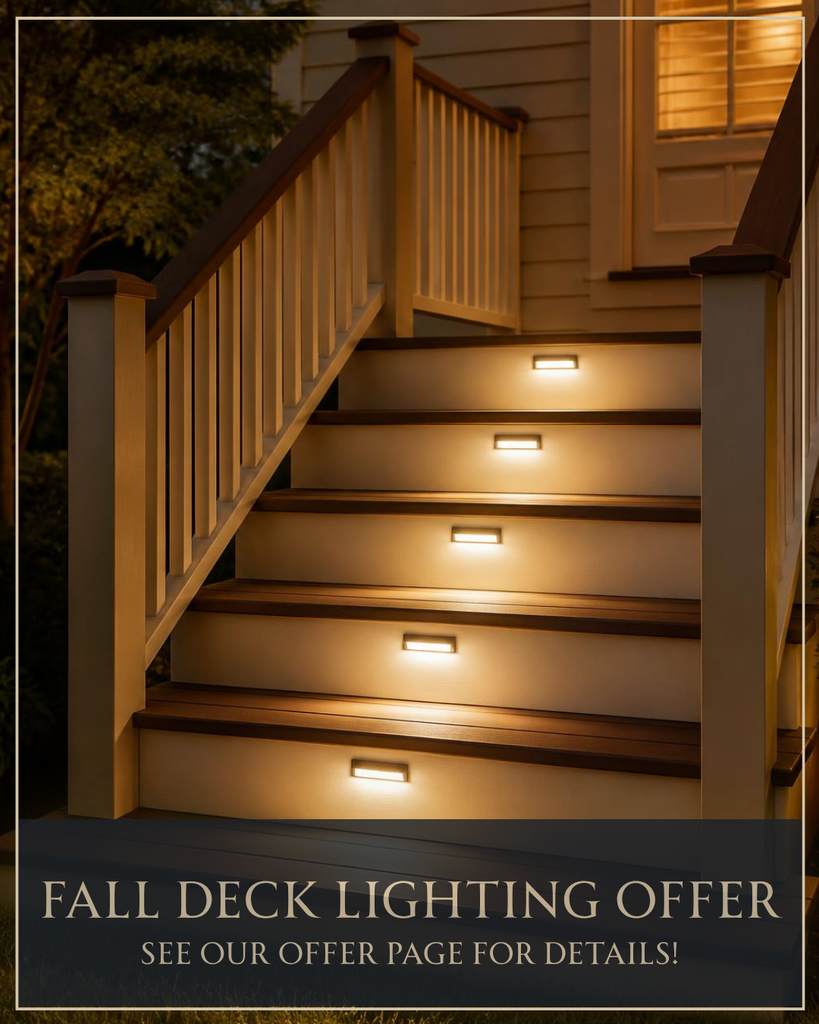
And if you’re building new, our September offer applies: book a new deck or screened porch project by September 30th and get a complimentary lighting package at no extra cost, because most of the best moments on a deck happen after the sun goes down anyway. Full terms are on our special offer page.
If you want to see what a fall day at Grandad’s Apples looks like for yourself, grandadsapples.com has the details, apples are usually available through the season, with pumpkins and the corn maze rounding out the visit.
We’d love to help you build your own version of Luke’s Saturday. Book a free estimate or call us at (980) 414-0320.
There’s a first cool evening every fall in Charlotte, usually sometime in October, when everyone’s still outside after dinner and nobody wants to go in yet. If you’ve got a fire pit or fireplace, that’s the night it earns its keep. If you don’t, it’s usually the night you start wondering why you don’t.
Fire features are one of the most requested additions we build, and for good reason, they extend your outdoor season by months and turn a deck, patio, or porch into the place people actually want to gather.
But not all fire features are built the same, and the difference between a quality build and a corner-cut one isn’t always obvious until something goes wrong.
Fire Pit or Fireplace: Different Builds, Different Considerations
A fire pit and an outdoor fireplace solve similar problems in genuinely different ways, and the right call depends on your space and how you plan to use it.
A fire pit is typically a lower, more casual gathering point, often the centerpiece of a patio or the anchor of a deck’s seating area, and works well for groups who want to sit in a circle and talk.
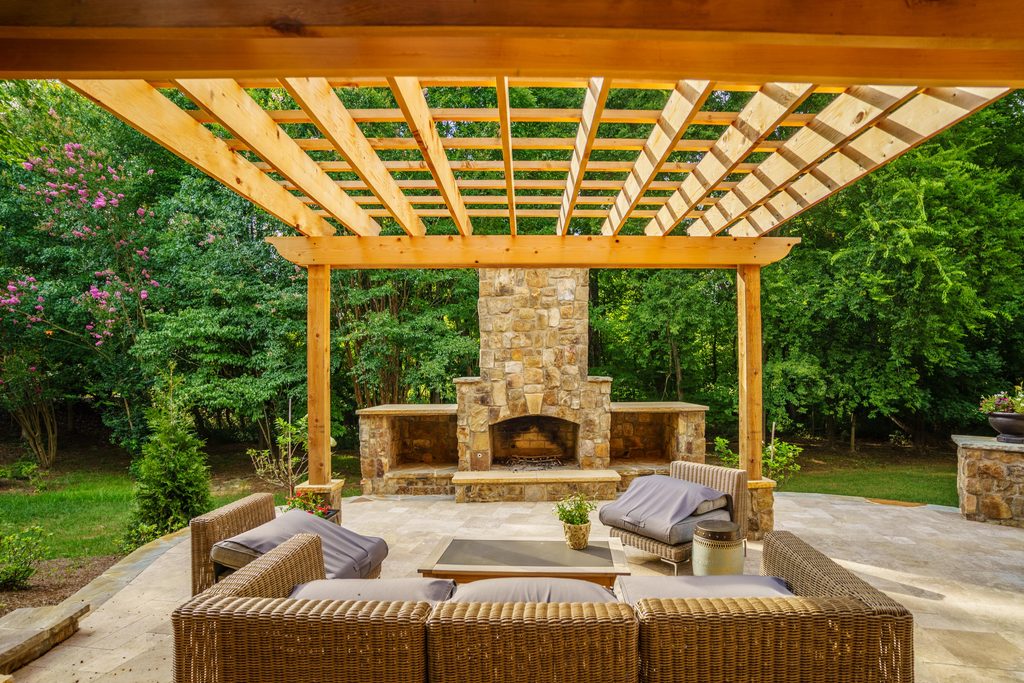
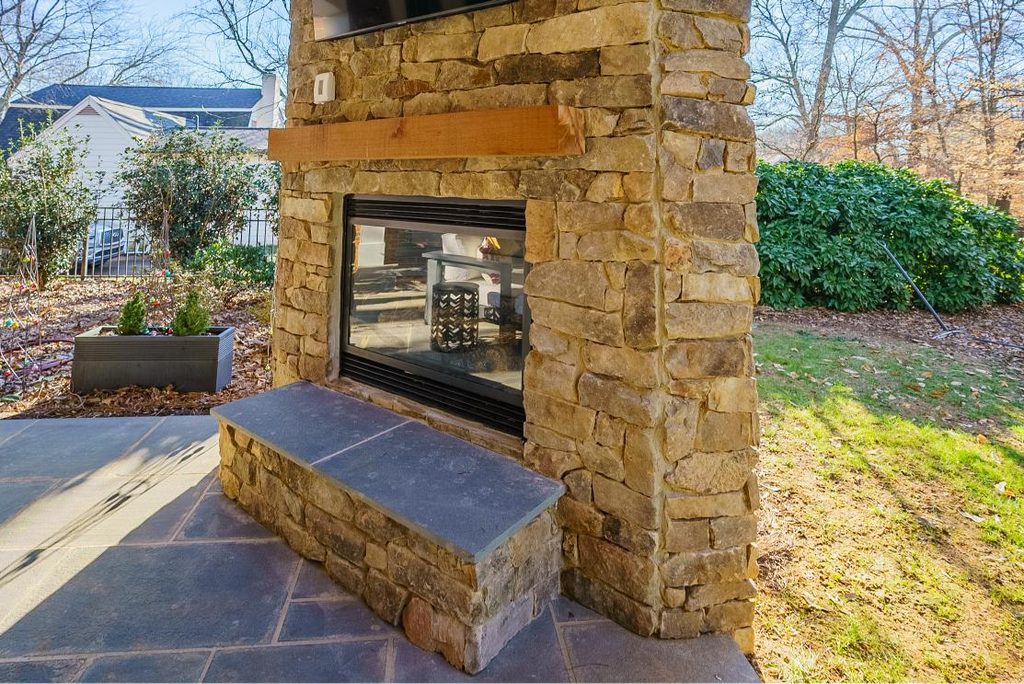
An outdoor fireplace is a more architectural statement, usually built against a wall or as a standalone structure, and tends to define an outdoor room the way an indoor fireplace anchors a living room.
Both can run on wood or gas, and that choice matters more than people expect: gas gives you instant ambiance with none of the smoke or maintenance, wood gives you the crackle and scent a lot of homeowners are chasing in the first place. There’s no universally right answer, it depends on how you actually want to use the space.
What Separates a Quality Fire Feature Build
This is where it gets technical, and where corners get cut in ways homeowners often don’t discover until years later. Proper clearance is non-negotiable: fire features need real distance from combustible materials, and that distance isn’t a suggestion, it’s dictated by code and the specific materials involved. Footings matter more than most homeowners think about: a masonry fire feature is heavy, and it needs a footing engineered to support that weight without shifting or cracking over time, especially through Charlotte’s freeze-thaw cycles.
But the quality differences that matter most are often in the details nobody thinks to ask about.
Joist and post sizing around a fire feature needs to account for the added weight and structural demands, not just match the rest of the deck by default.
Proper flashing where the fire feature meets the structure keeps water from finding its way in over time, a detail that’s invisible once the build is finished but shows up as rot or damage years later if it’s skipped.
Taped blocking at seams and transitions is another one of those steps that takes extra time and never gets seen, but it’s the difference between a tight, long-lasting build and one that starts failing quietly. And on stairs near a fire feature or anywhere else on the deck.
Picture-framed stair treads, where the border boards wrap the ends of the stair for a finished look, are a small design detail that signals a builder who’s paying attention to craftsmanship, not just function.
Questions to Ask Before Hiring a Fire Pit or Fireplace Builder
How far does a fire pit need to sit from my deck railing or siding? Clearance distances are dictated by code and by the specific materials involved, not a general rule of thumb. A contractor who knows what they’re doing can tell you the exact distance your fire feature needs from your railing, siding, or decking, and explain why. Vague or general answers here are a red flag.
Does the joist and post sizing near my fire feature need to be different from the rest of my deck? Yes. The added weight and structural demands of a fire feature mean joists and posts nearby often need to be sized specifically for that load, not just matched to the rest of the deck by default. Ask your contractor directly whether this has been accounted for in the plan.
What is flashing and blocking, and why does it matter for a fire feature? Flashing keeps water from getting into the structure where the fire feature meets the deck or porch, and taped blocking reinforces seams and transitions. Neither is visible once the build is finished, but skipping either is a common way builds start failing quietly within a few years. Ask whether both are part of the plan from the start.
What’s a red flag when getting quotes from multiple contractors? If a contractor can’t speak specifically to clearance distances, joist and post sizing, or flashing and blocking, that’s usually a sign the build won’t hold up the way it should. A builder who knows what they’re doing will have clear, specific answers to all three, not general reassurance.
Quality Fire Pit and Fireplace Builders in Charlotte: What We Never Skip
We build fire pits and outdoor fireplaces as part of larger composite deck, porch and patio, and outdoor living projects across the Charlotte metro, and it’s one of the areas where the gap between “looks fine” and “built right” shows up fastest.
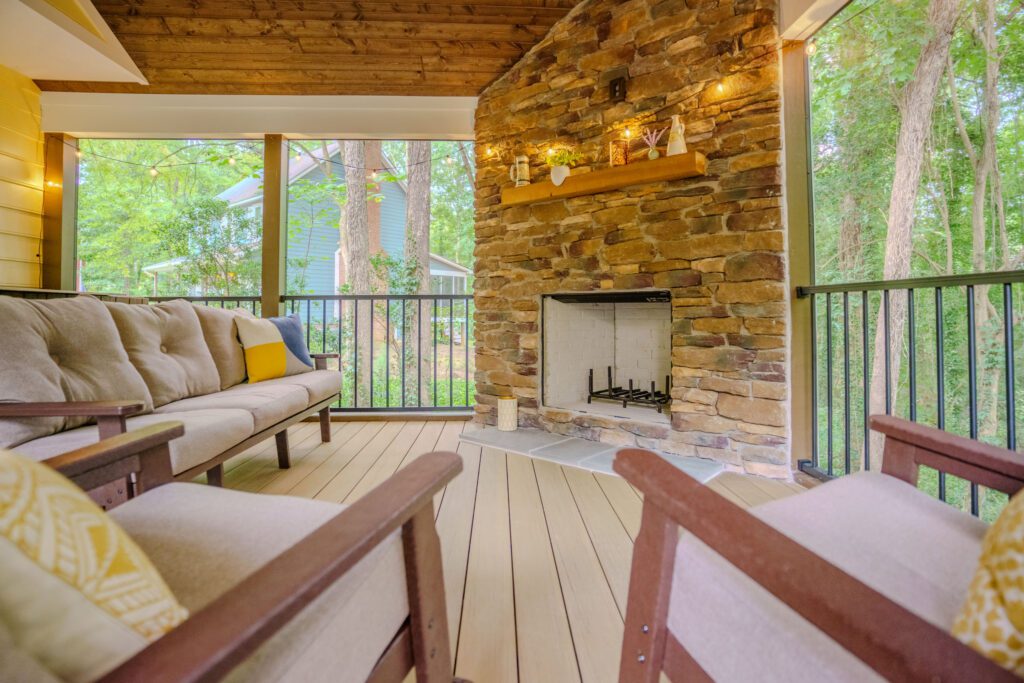
We spec proper footings, correct joist and post sizing, flashing, and taped blocking on every fire feature we build, along with finishing details like picture-framed stair treads, whether it’s a simple gas fire pit or a full stone fireplace anchoring a screened porch. It’s not the most exciting line item to explain to a homeowner, but it’s the one that determines whether your fire feature, and the deck around it, is still solid in ten years, or a problem you’re dealing with in three.
It’s part of why we build exclusively with premium materials and construction standards, the visible finish is only half the story; what’s underneath is what actually protects your investment.
A Fall Detail Worth Mentioning
If a fire feature is part of a larger deck or screened porch build you’re considering, our September offer applies: book a new deck or screened porch construction project by September 30th, 2026 and we’ll include a complimentary deck lighting package at no extra cost. Fire features and lighting tend to go hand in hand anyway, both are about making your outdoor space usable long after the sun goes down. Full terms are on our special offer page.
Building It Right, the First Time
Whether you’re picturing a stone fireplace anchoring a screened porch in Myers Park or a simple gas fire pit for weeknight dinners on a deck in Matthews, the build quality behind the feature matters more than the design on top of it.
We’re happy to walk through what a proper fire feature build looks like for your specific space, clearances, footings, materials, all of it, before you commit to anything.
There’s a specific kind of Saturday in Charlotte that starts showing up around mid-September: the air finally loses its grip of humidity, the light turns gold a little earlier, and suddenly the deck you’ve been avoiding since July feels like the best seat in the house again. If you own a composite deck or a screened porch in Charlotte, a little fall deck maintenance now goes a long way toward keeping it ready for the months ahead.
Before you drag the cushions back out and light the first fire of the season, it’s worth doing a quick once-over on your outdoor space. Not a project. Not a weekend of work. Just a checklist, so the next few months of tailgates, bonfires, and cool-evening dinners happen on a deck or porch that’s actually ready for them.
Composite Decking Maintenance: The Short List
One of the quiet benefits of composite decking that nobody mentions until you’re the one doing it: fall prep takes about twenty minutes.
Sweep the boards and check the gaps between them for trapped leaves, pollen, or debris, since buildup there is what eventually holds moisture against the board edges.
Give the railing a once-over. Composite and aluminum railing systems don’t need much, but it’s worth checking that post caps are secure and nothing’s come loose over a summer of use.
If your deck has a built-in kitchen, fireplace, or fire feature, check that hardware and connections are solid before you’re relying on them for a football Saturday.
That’s genuinely most of it. If you installed composite decking with us, or with any composite decking installer in Charlotte NC worth their reputation, this is the extent of your fall maintenance. No sanding. No staining. No annual sealant. It’s one of the clearest arguments for composite over pressure-treated wood, and fall is when you feel the difference most, because this is exactly the season wood owners are gearing up for their least favorite chore.
Deck Maintenance for Wood: Your Last Window Before Winter
If you’re still working with pressure-treated wood, early-to-mid fall is genuinely your last good window to stain or seal before temperatures drop and humidity swings start working against you. Charlotte’s freeze-thaw cycles are milder than they are further north, but they’re not nothing, and untreated wood heading into winter is wood that’s going to show it by spring. If you’ve been putting this off, now’s the time, not November.
And if the walkthrough turns up something bigger than a maintenance task, soft or spongy boards, a railing that flexes more than it should, posts that feel loose, that’s not a fall DIY project. That’s a conversation about resurfacing, and it’s one worth having before winter rather than after.
Screened Porches and EzeBreeze Rooms: A Slightly Different List
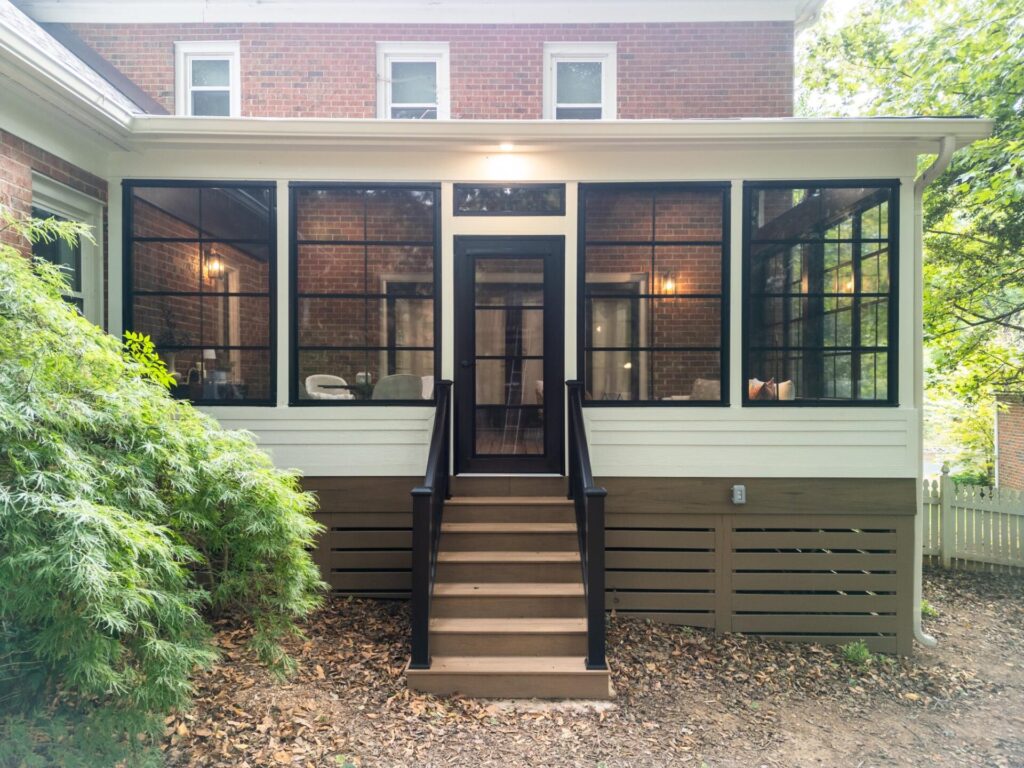
If your outdoor living space includes a screened porch charlotte homeowners built to actually use, fall prep looks a little different.
Check your screens for tears or gaps, small ones only get more tempting to bugs as the weather cools and everyone wants the windows and doors open.
If you have EzeBreeze panels, this is a good time to confirm they slide and lock properly before you need them for a chilly October evening.
Clean the gutters and roofline above the porch before leaf season hits in earnest; a screened porch with a clogged gutter overhead defeats half the point of having one.
And if your porch has a ceiling fan or infrared heater built in, test both now so you’re not troubleshooting mid-party.
The Small Stuff That Makes a Real Difference
A few smaller items round out the list, and they’re the ones that actually shape how much you use the space over the next few months.
Outdoor cushions and rugs that spent the summer outside should either come in or get a proper cleaning and weatherproofing before humidity gives way to damp fall mornings.
If you have a fire pit or outdoor fireplace, give it a look before the first cool-night fire, we’ll go deeper on what separates a well-built fire feature from a corner-cut one next week, but for now, just confirm everything looks structurally sound.
And if you’ve been meaning to add string lights or path lighting for the extended evening season, fall is when you’ll actually notice the difference, since sunset starts creeping earlier by the week.
Speaking of Lighting: A Fall Offer Worth Knowing About
If your fall walkthrough has you dreaming bigger than a checklist, and you’ve been considering a new deck or screened porch entirely, we’re running something worth mentioning: book a new deck or screened porch construction project with us by September 30th, and we’ll include a complimentary deck lighting package, no extra cost.
It’s the detail that turns a beautiful deck into a space you actually use after the sun goes down, and we design lighting in from day one so it looks intentional, because it is. Full terms are on our special offer page.
When the Checklist Turns Into a Bigger Conversation
We hear from a lot of homeowners this time of year who started with a simple walkthrough and ended up realizing their deck or porch isn’t quite keeping up with how they actually want to use their backyard, whether that’s a family in Ballantyne looking to finally screen in an open deck, or a homeowner in Waxhaw whose ten-year-old pressure-treated deck is telling them it’s time for composite.
That’s exactly the conversation we’re built for. We handle permitting across Mecklenburg, York, and Cabarrus counties, so whether you’re in Fort Mill, Matthews, Indian Trail, or anywhere else in the Charlotte metro, it’s never something you have to manage yourself.
Fall in Charlotte is short but extraordinary, and it’s worth spending it on a deck or porch that’s actually ready for it.
If your walkthrough turns up more than a quick fix, we’d love to talk about what’s possible. Book a free estimate or call us at (980) 414-0320.
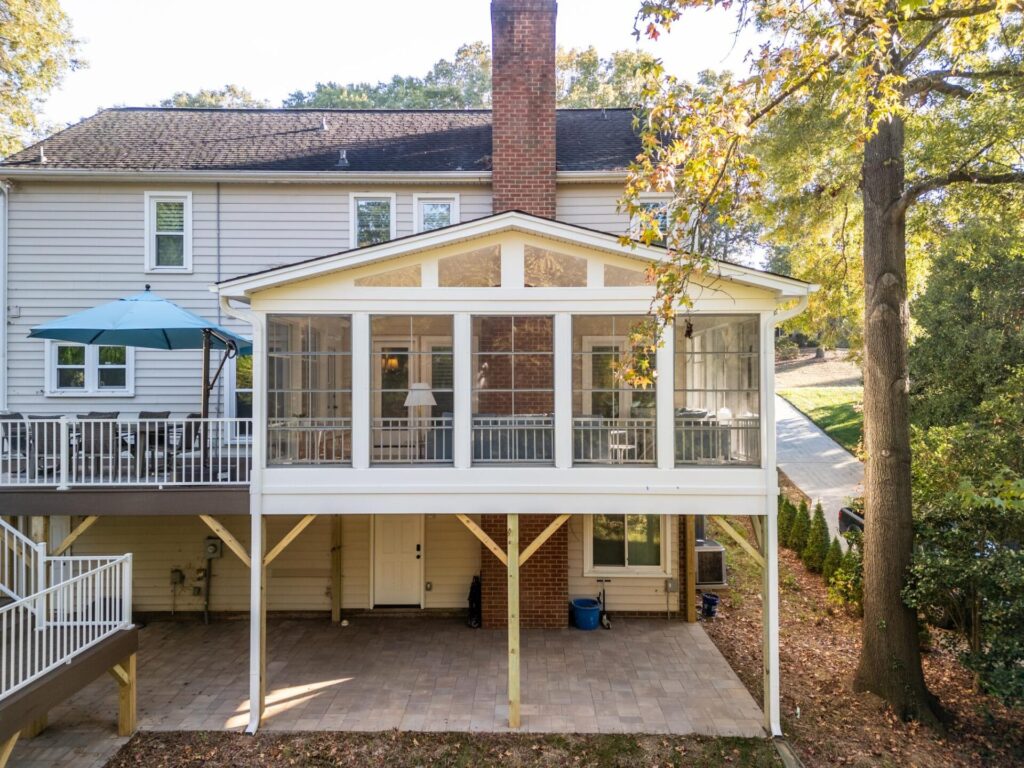
If you already have a covered porch, or you’re planning one as part of a larger build, there’s a good chance you’ve landed on the same question a lot of Charlotte homeowners ask us: do we need a full sunroom, a traditional screened porch, or is there something in between? The honest answer is that for most homeowners, there is, and it’s called Eze-Breeze.
What Is an Eze-Breeze Porch Enclosure?
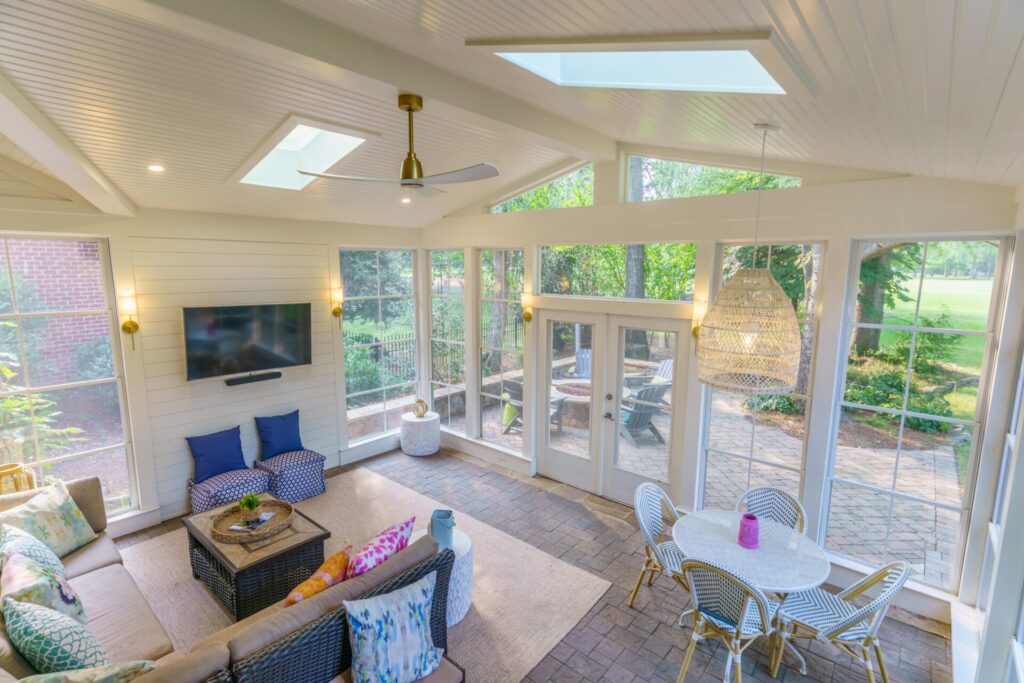
Eze-Breeze is a porch enclosure system built around a simple idea: give you most of the comfort and weather protection of a full glass sunroom at a meaningfully lower investment. The frames are aluminum, built for strength and long-term rigidity, and the clear panels are a flexible, 10-mil vinyl glazing engineered specifically for porch applications.
Together, they create a system that slides open for full ventilation on a beautiful Carolina evening, or closes up tight when weather rolls through.
It’s not a screen, and it’s not a true four-season sunroom with heating and cooling built in. It’s the space in between, which is exactly the point for most of the ways Charlotte families actually use a porch. It’s a system we install often because it solves a real problem for Charlotte homeowners without overbuilding the space.
Screened Porch vs. Sunroom vs. Standard Screens
Homeowners weighing this decision are usually comparing three real options, and each one solves a different problem:
Standard Screened Porch
Eze-Breeze Enclosure
Full Glass Sunroom
Investment level
Lowest
Mid-range
Highest
HVAC required
No
No
Often, for true year-round use
Weather protection
Screen only
Wind, rain, pollen, and cool drafts blocked when closed
Full weather and temperature control
Usable months in Charlotte
Spring through early fall
Nearly year-round for most Carolina winters
Year-round
Structural changes needed
Minimal
Minimal, fits most existing porch footprints
Often significant, foundation and framing upgrades
For most Charlotte homeowners, a standard screen doesn’t do enough, and a full glass sunroom does more (and costs more) than what they actually need. Eze-Breeze sits in the middle: real weather protection, real usability, without the structural lift of a true sunroom conversion.
The Real Advantage: Comfort Without the Sunroom Price
When we install an EZE-Breeze system, it delivers the multi-season comfort of a glass sunroom for meaningfully less investment.
You get real protection from wind, rain, and pollen, real temperature moderation compared to an open-air porch, and a space you can actually use from early spring through late fall, all without paying for the foundation and structural upgrades a true sunroom conversion requires.
For homeowners weighing “do we really need a full sunroom, or do we just need a comfortable, weatherproof porch,” Eze-Breeze is very often the answer that makes the most sense, both for the budget and for how the space actually gets used day to day.
Built to Handle Charlotte’s Climate (Pollen Included)
Charlotte’s humid summers and freeze-thaw winters are hard on outdoor structures that aren’t built with the right materials. Eze-Breeze’s aluminum framing resists warping, rot, and the temperature swings that make wood-frame enclosures a maintenance headache over time. The vinyl panels are designed to hold their clarity and flex back into shape rather than crack under impact.
And then there’s spring pollen season, which anyone who’s lived in Charlotte for more than a year knows is no small thing. A yellow film settles over everything left exposed, furniture, cushions, floors, for weeks at a time.
With the panels closed, an Eze-Breeze enclosure keeps that pollen off your porch furniture entirely, turning what’s usually the most frustrating month for outdoor living into just another comfortable week on the porch.
Frame and Panel Options
Eze-Breeze systems come in a range of frame colors and vinyl tint options, so your enclosure can complement your home’s existing look rather than feeling like an add-on.
We’ll walk you through the options during your consultation and help you choose what fits both your home’s style and how you plan to use the space, whether that’s a quiet reading nook, an entertaining area, or an evening spot for the whole family.
What to Expect: Retrofit vs. New Build
If you’re building a new porch, pricing typically starts around $20,000 for a 10×10 structure, covering the roof and related structure only. That starting point assumes you’re adding onto an existing, structurally sound deck or patio. If your project includes both a new porch and a new deck or patio underneath it, we’ll price each component separately so you have a clear picture of the full investment.
Because panel count, site conditions, and custom finishes vary, exact pricing depends on your space. During a free consultation, we’ll walk your site, take precise measurements, and deliver an accurate proposal tailored to your home.
Care, Cleaning & Maintenance
One of the quieter advantages of EZE-Breeze is how little upkeep it actually requires. The panels clean easily with Woolite® or Murphy Oil Soap® mixed with warm water. Skip dish soap, ammonia-based cleaners like Windex, and anything abrasive; those can cloud the vinyl or void the warranty.
A soft cloth and a twice-yearly cleaning is genuinely all it takes to keep the panels looking clear.
A Product We Trust, Backed by Our Own Craftsmanship
We don’t put our name on a screen enclosure system unless we’re confident it’ll hold up in a Carolina climate for the long haul. Eze-Breeze earned a place in our lineup for exactly that reason, it’s been in business since 1980, with panels installed in thousands of homes nationwide and backed by a real warranty.
But choosing a good product is only half the job. The other half is precise measurement, a clean installation, and finish work that makes the enclosure feel like it was always part of your home, and that’s the part our crew handles on every single project.
See What Carolina Decks Can Build For You
We’ve designed and installed EZE-Breeze enclosures across the Charlotte metro, from simple porch retrofits to full custom builds with outdoor fireplaces and kitchens attached. Every project gets the same design eye and attention to detail, because the product is only as good as the install behind it.
If you’re picturing a porch you can actually use through October evenings and even into a mild Carolina winter, let’s talk about what that looks like for your home.
Good outdoor deck lighting doesn’t just make your deck look great after dark, it changes how you use your entire outdoor living space. But not all deck lighting installations are created equal. Here’s how to know the difference before you invest.
How Professional Deck Lighting Installation Transforms Your Space
If you live in the Charlotte area, you already know: summer evenings here are worth staying outside for. Think about the last time you came home from Sounds of Summer at Blakeney or a show at PNC Music Pavilion and the evening just kept going on the back deck. The music stopped, but nobody was ready to call it a night. Good lighting is what makes that possible as it extends your living space into the evening and gives every gathering room to breathe.
Beyond entertaining, outdoor lighting serves some practical purposes that are easy to overlook until something goes wrong. Well-placed fixtures illuminate steps, level changes, pathways, and transitions between spaces, the spots where someone unfamiliar with your yard is most likely to have an issue. Lighting those areas well isn’t just thoughtful design, it’s considerate hosting.
And then there’s mood. The right layering of ambient glow, directional accents, and warm task lighting can make a deck feel like a destination, a room you designed with intention, not just an elevated wooden platform attached to the back of your house.
The catch? Lighting only delivers all of that when it’s installed correctly. When it’s not, you get flickering fixtures, mismatched brightness, and wiring that wasn’t built to last or to be safe. When you invest in professional deck lighting installation, it changes how you use your entire outdoor living space
Designing a Custom Low-Voltage Deck Lighting Plan by Zone
Most outdoor spaces aren’t just a deck. They’re a collection of connected spaces that serve different purposes and the best lighting plans treat them that way. A quality installation starts by mapping out those zones before a single fixture is spec’d.
Deck + lower patio: Multi-level builds need lighting that ties the levels together. Stair risers, post caps, and under-rail strips create a connected flow rather than two separate spaces. Low-voltage systems handle this elegantly when they’re designed in from the start.
Deck + outdoor kitchen: The grill and prep area need brighter task lighting. Ambient or accent lighting for the dining zone keeps things separate but cohesive, two functions, two feels. Where line-voltage pendants or overhead fixtures make sense under a covered structure, a quality build coordinates that work with a licensed electrician before construction begins, not as a retrofit.
Covered porch + open air: Overhead fixtures under the roof and low-voltage accents in the open area need to balance in brightness so neither space looks washed out or too dim by comparison.
Pergolas are their own lighting conversation. Because they’re open structures, they rely entirely on what’s built into them: string lights routed through the beams, pendant drops, or integrated post-cap fixtures. A pergola without a lighting plan is a pergola you stop using at sunset.
What you want to avoid in any of these configurations: plug-in fixtures routed through surface-mounted channels, or indoor-rated components pressed into outdoor service because they were available.
Five signs the lighting was done right
Whether you’re evaluating an existing deck or making decisions about a new build, here’s what a quality installation actually looks like:
Wiring is routed cleanly through the structure. On a quality build, wiring runs inside the deck framing, through joists and posts, not along the surface with staples or zip ties. You shouldn’t be able to trace the wiring path by looking at the finished deck.
Every fixture is rated for outdoor wet locations. This is on the label as UL wet-location listed. It matters especially in the Carolinas, where humidity, heat, and afternoon storms are a regular part of the season. Using anything less is cutting corners on durability.
The transformer is properly sized with load calculations. A low-voltage system runs through a transformer, and that transformer needs to be matched to the actual load on the circuit. Too small and you’ll have flickering; too large and you’re overpaying for a piece of hardware you don’t need. A quality installation documents this.
Fixtures were integrated during the build, not added afterward. Seamless deck post cap lights, flush-mounted stair riser lights, and in-deck low-voltage LED step lights need to be considered before framing is complete. When lighting is part of the design from day one, the integration is seamless. When it’s retrofitted, you’ll see it in surface patches, visible mounting hardware, and caulk fills that were never quite the right color.
Light levels are consistent and balanced. Flip the lights on at dusk and walk the space. There shouldn’t be bright spots near the transformer and dim zones at the far ends of the run. No flickering. No fixtures that are clearly brighter or dimmer than their neighbors. Balanced, even light from every fixture is the result of proper circuit planning.
Five red flags that signal a shortcut
We aren’t out to scare you as most deck lighting issues aren’t emergencies. But they are signals that corners were cut, and they tend to compound over time. As trusted outdoor lighting contractors in Charlotte, NC, we see the difference daily.
Here’s what to watch for:
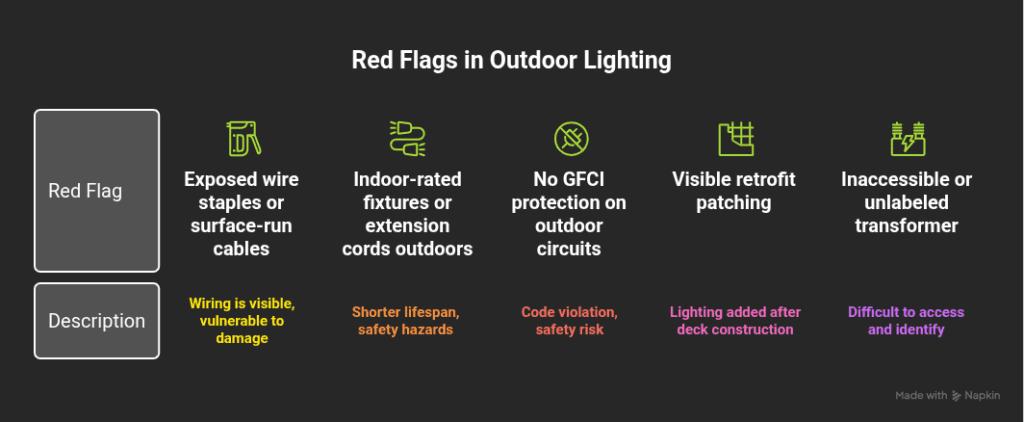
Exposed wire staples or surface-run cables. If you can see where the wiring goes, that’s a flag. Staples and surface channels are quick and they’re also vulnerable to foot traffic, UV exposure, and the kind of moisture that accelerates corrosion.
Indoor-rated fixtures or extension cords in outdoor applications. Indoor fixtures have a shorter service life outdoors and can create safety hazards. Extension cords were never designed to be permanent wiring. Both are common shortcuts that look fine at first and cause problems within a season or two.
No GFCI protection on outdoor circuits. Ground fault circuit interrupter protection is code-required for outdoor electrical and for good reason. If your outdoor outlets or fixtures aren’t on a GFCI-protected circuit, that’s a conversation to have with a licensed electrician.
Visible retrofit patching. Caulk fills in post caps that don’t quite match, mounting plates sitting proud of the surface, or misaligned fixture cutouts are all signs that lighting was figured out after the deck was built. It doesn’t necessarily mean the lighting won’t work, but means it wasn’t intentionally designed.
A transformer in an inaccessible or unlabeled location. You should know where your transformer is, what circuit it’s on, and be able to get to it. If it’s tucked behind lattice with no labeled breaker and no documentation, that’s a setup for frustration the first time something needs attention. Deck lights flickering or dimming? Usually means a transformer wasn’t properly sized with load calculations.
What a custom lighting plan actually looks like from the start
When lighting is part of the conversation from day one, the result is different in ways that are immediately visible and in ways that quietly pay off over years of use.
A design-first approach means layering three types of light across your outdoor space: ambient light that sets the overall tone and brightness, task lighting in functional zones like cooking and prep areas, and accent lighting that highlights the details like rail profiles, architectural posts, stair edges, and transitions between materials.
It also means selecting fixtures that work with the rest of the design, not against it. Bronze hardware on a dark-stained IPE deck reads differently than brushed nickel on a painted composite rail. Fixture quality matters too and aluminum and brass housings hold up in Carolina heat and humidity far better than plastic (and they’ll look better doing it).
If you’re already thinking about home automation, it’s worth knowing that most quality low-voltage systems today are compatible with smart home controls, meaning your deck, pergola, and landscape lighting can all run on a single app or integrate with what you already have indoors.
One thing we always talk through with homeowners: your deck lighting and your landscape lighting should feel like one system, not two separate afterthoughts. Path lights along the walkway, lighting along the driveway edge, garden bed accents, when those tie into the same design as your deck, the whole property reads as intentional after dark.
When we sit down to design a deck, lighting is always part of that first conversation, not a line item we revisit at the end. The decisions made during framing determine what’s possible with lighting later. That’s why we ask about how you use your space in the evening, not just during the day.
A quick note on permits and electrical work
In Charlotte and across the surrounding counties, electrical work on structures requires permits and outdoor deck lighting, especially anything involving line-voltage circuits, is no exception. A quality builder coordinates with a licensed electrician, pulls the appropriate permits, and passes inspection. That documentation protects your investment and matters when it comes time to sell.
If you’re reviewing a proposal and electrical work is mentioned without any reference to permitting, it’s worth asking the question directly. The answer tells you a lot about how the rest of the project will be managed.
Ready to start the conversation?
Good outdoor lighting happens by design. If you’re beginning to think about your outdoor living space in the Charlotte metro, we’d love to be part of that conversation early. The earlier lighting is in the plan, the better the result.
The Truist Championship just wrapped at Quail Hollow. Charlotte’s backyard season is officially open — is yours ready?
Something happens to Charlotte in early May. The azaleas are still blooming, the evenings have finally turned warm without the humidity hitting yet, and for one week every year, Quail Hollow Club puts the city’s south neighborhoods on a national stage. Neighbors grab tickets, coworkers tailgate in the SouthPark Mall parking lot, and for a few days the whole city is outside together, reminded of exactly how good it is to live in the Queen City when the weather cooperates.
And then it’s May 23rd. The tournament is over, summer is two weekends away, and a lot of Charlotte homeowners are standing in their backyards thinking the same thing: I really need to do something about this space.
That’s exactly where we like to start.
Charlotte’s Backyard Season Waits for No One
There’s a short, sweet window between the Truist Championship and the Fourth of July where the stars align for getting a custom deck or porch build done right. The weather is workable and the kids aren’t out of school yet. There’s still time, barely, to have a finished, inspected, beautiful outdoor space before the summer entertaining season hits full swing.
We’re not going to sugarcoat the timeline: custom builds take time. Quality materials have lead times. Permits through Mecklenburg County move at their own pace. And any crew worth hiring in this city is already booking out. If this has been on your list, the window to act is right now, not after Memorial Day.
“Every great backyard in this city started with someone finally making the call.”
What Tournament Week Reminded Us All
One of the things we love about Truist Championship week is that it gets Charlotte outside. People who haven’t dusted off their lawn chairs since last fall are suddenly spending full days outdoors and remembering how good it feels. You reconnect with your neighbors. You notice the houses that have really invested in their outdoor spaces. And you come home and look at your own backyard with fresh eyes.
That’s not a bad thing, it’s motivation.
The neighborhoods surrounding Quail Hollow – Myers Park, SouthPark, Ballantyne, the communities stretching down toward Waxhaw – are full of homeowners who care deeply about their properties. We know our neighbors aren’t looking for a quick fix or a builder who’s going to cut corners on the framing. They want something designed thoughtfully, built to last, and finished to a standard that matches the rest of their home.
That’s the work Carolina Decks does.
What a Custom Build Actually Looks Like
Every project we take on starts with a conversation, not a sales pitch. We want to know how you live. Do you host big or small? Morning coffee or evening wine? Kids running in and out, or a quieter retreat? Do you want to grill under cover, or is the view the whole point?
From there, we customize the design for your lifestyle. This season in south Charlotte we’re building:
Multi-level decks that give families real separation between cooking, dining, and lounging so the whole space actually gets used instead of everyone crowding around the grill.
Covered structures and screened porches that push the Charlotte season earlier in spring and later into fall. A well-designed pergola or screen enclosure is the difference between a space you use three months a year and one you use eight.
Built-in lighting that means you’re not packing up when the sun goes down. Some of the best evenings on a Charlotte deck happen after dark.
All of it built with materials chosen specifically for our climate: composite decking that handles Carolina humidity, structural framing done right from the ground up, finishes that look as good in year seven as they did on day one.
We’d Love to Talk About Your Backyard
Carolina Decks works across the Charlotte metro including Myers Park, SouthPark, Ballantyne, Waxhaw, Lake Norman and everywhere in between. We specialize in custom outdoor living spaces for homeowners who are ready to build it right the first time and actually use it.
If tournament week got you thinking about your backyard, we’d love to be the first call you make. Summer is coming fast so let’s get you ready for it. Book a free estimate or call us at (980) 414-0320 and let’s talk about your future summers.
Charlotte in May and early June is about as close to perfect outdoor weather as you’ll find anywhere. Look forward to warm evenings with the days still long enough to make a backyard gathering feel unhurried. If your family has a graduation this spring, an outdoor party is the obvious move. Here’s how to make it work.
Think in Zones, Not One Big Open Space
The instinct with a larger party is to just push everything to the edges and let people spread out. A better approach is to think in three distinct zones: a food and serving area, seating for guests who want to settle in, and open space for mingling and movement.
A well-designed deck or patio handles the first two naturally. It gives you a defined, level surface for your serving table and a place to anchor comfortable seating for older guests who don’t want to stand for two hours. The open yard becomes the flow zone: keep it clear, and the party moves the way you want it to.
If you have a screened porch, use it. It becomes the quiet room, cooler, bug-free, and a natural gathering spot for guests who want a real conversation without competing with the crowd. A screened outdoor living space earns its keep on a day like this.
The One Thing Most Charlotte Hosts Forget: Shade and a Rain Backup
This is the one that catches people off guard every year. Charlotte’s May afternoons can reach the mid-80s, and late-day pop-up storms are a real feature of spring in the Carolinas, not a rare exception.
Shade matters more than most hosts plan for. A covered structure (a pergola, a porch roof, even a well-positioned sail shade) keeps the food table out of direct sun and gives older guests a place to sit comfortably without retreating inside.
For rain, have a plan before the day arrives. A covered outdoor space means the party continues regardless of what rolls through. If you don’t have a permanent covered structure, rent a 20×20 canopy tent and set it up the day before, not the morning of, so you’re not scrambling while guests are arriving. Position it to preserve the natural flow between your deck and the yard rather than blocking it.
Making Your Deck Work for a Crowd
A deck that comfortably seats eight can accommodate twenty or more people when it’s set up right. Clear the furniture you don’t need. A custom deck with open railing and clean sightlines feels expansive with people on it; one that’s crowded with patio sets feels cluttered.
A few details that make a real difference:
String lights run along a pergola or railing immediately shift the atmosphere as the evening moves in. It’s the single highest-return detail for an outdoor party.
An outdoor rug anchors the seating area and signals intention. A rug makes the space feels designed rather than assembled.
Flow from the kitchen matters more than most hosts realize until they’re on their fourth trip across the yard carrying a tray. The fewer steps between food prep and the serving table, the better your experience as a host.
This Might Be the Year
If you’re deep in graduation party planning right now, there’s a good chance you’ve already had the thought: This backyard could be so much more than this.
Maybe it’s watching guests bunch up on a small concrete slab. Maybe it’s realizing a covered pergola would have solved the whole rain problem before it started. Or maybe it’s just standing outside after everyone leaves and thinking next year is my year.
Spring projects booked in April can often be finished before summer. Custom deck builds and screened porch additions take planning, and the best build windows in the Charlotte metro fill up faster than most homeowners expect. You don’t have to watch another season go by from the same backyard.
If you’re thinking about making next year’s party, and next summer’s weekends, look completely different, we’d love to talk. A free estimate takes about 30 minutes, and we’ll give you an honest picture of what’s possible and what it costs.