
The Ledger Board: The Most Important Detail on Your Charlotte Deck
The deck ledger board is where your deck connects to your house and it’s the most common source of deck structural failures nationwide. It’s also the one detail most homeowners never think about until something goes wrong. Here’s what proper ledger board attachment looks like, and the three red flags that mean yours might have a problem.
What the ledger board actually is
The ledger is a horizontal board that, in most cases, is bolted directly to the rim joist or band joist of your home’s floor framing. It’s one of the primary load bearing structural components of your entire deck as half of everything that deck holds runs through this single connection point.
Incorrectly attached ledgers are responsible for the majority of deck collapses, and the failure is almost always sudden, usually under load (like in the middle of dancing a party). The other challenge: once your decking surface is down, you can’t see the ledger board. Which is exactly why structural integrity at this connection point is worth understanding before the build begins.
What correct ledger board attachment looks like
- Proper fasteners: Structural screws, lag screws, or lag bolts in a staggered pattern: not nails, not standard deck screws. The fastener choice alone is one of the clearest indicators of build quality.
- Flashing: Correctly installed Z-flashing, flashing tape, or a proprietary ledger flashing system that directs water away from the house connection. Water damage behind the ledger is one of the leading causes of long-term structural issues, and in Charlotte’s unpredictable rain, this detail protects your investment for the long term.
- Connection into framing: Fasteners must hit the actual floor framing, not sheathing or siding. An experienced contractor will know to locate the rim joist before installing the ledger board.
- Code compliance: All county building inspectors will check for correct ledger board attachment and flashing details on every permitted deck. Working within local building codes isn’t just a formality, it’s what ensures the structural soundness of the finished build. Any property owner with a permitted deck will have this detail on record with the building department.
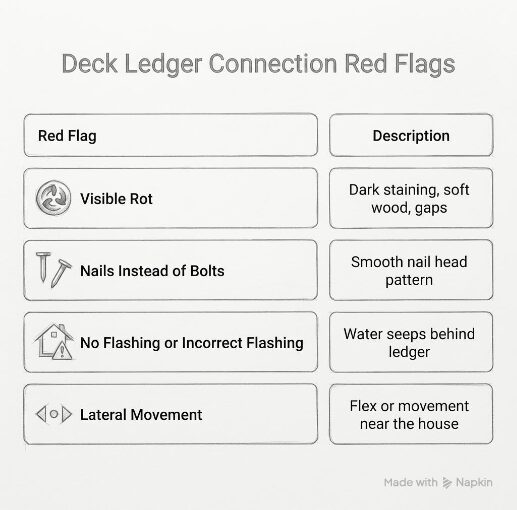
Three red flags on an existing ledger
- Visible rot at the connection point. Dark staining, soft wood, or gaps where the deck ledger meets the house are signs that water damage has already set in. This kind of deterioration affects the surrounding structural components quickly.
- Nails instead of bolts. You can tell by the fastener head pattern. Nails are smooth while lag screws and lag bolts have hex heads. If you see a nail pattern on an older Charlotte deck, that’s worth a closer look.
- No flashing, or flashing installed incorrectly. If water can get behind the deck ledger, rot follows. This is one of the most common structural issues we see on decks built before current local code requirements.
- Any lateral movement near the house. Push gently on the deck frame close to where it attaches to the house. It should feel completely solid. Any flex is a sign that the structural integrity of that connection deserves attention.
What to do if you’re concerned
If your deck was permitted and built in the last ten years by a licensed contractor, you’re almost certainly in good shape as local code requires a structural inspection, and an experienced builder knows this detail matters.
If your deck is older, was built without a permit, or is a DIY build, it’s worth having someone take a look. Sometimes it’s a straightforward remedy. A fastener upgrade or flashing correction can restore structural soundness without a full rebuild. A NADRA-certified deck design and inspection professional can give you a thorough evaluation, document what they find, and walk you through your options.
But here’s the truth most homeowners don’t always want to hear: an older deck with a compromised ledger isn’t always a candidate for a targeted repair. By the time the structural issues are visible, the substructure, joists, and fasteners have typically aged right alongside it. At that point, the smarter conversation is often about what a thoughtfully designed new deck would look like and what it would cost. A licensed inspector or home inspector with deck experience can tell you honestly which situation you’re in.
Have a professional come evaluate your deck and give you an informed answer. It may be that some targeted repairs can correct the issue or it may be time for a new build. Either way, you’ll know exactly which direction makes sense for your home.
And if it’s time for a replacement, we’ll walk you through every step. We serve Charlotte, Ballantyne, Steele Creek, Huntersville, Waxhaw, and surrounding communities. Get an estimate for a new build or call us at (980) 414-0320.
Looking for inspiration? Check out our Project Gallery or read our previous blog post.